
Analysis: America held a big birthday party - and a soccer extravaganza broke out

The game the rest of the world knows as football is teaching America something about itself on its 250th birthday and reminding international visitors that the nation is far more welcoming and complex than its bitter political caricature. The World Cup’s gift of joy is a unifying distraction after tough years marked by ideological divides and a pandemic’s economic fallout.
And its blend of European and South American superstars and rising African and Asian teams is also holding up a mirror to the country’s own diversity and its enduring political experiment, enriched by immigration. The run-up to the tournament was fueled by concerns about over-commercialization, exorbitant ticket prices and the political expediency often shown by its governing body, FIFA.
But once the first ball was kicked, the players’ effervescence and the off-field party they conjured started to reveal a broader truth: The country is more layered and generous than endless feuding over Donald Trump’s turbulent presidency and anti-US attitudes abroad might suggest. Multiple diasporas that call America home are thronging the streets after games, reflecting the nation’s ethnic patchwork and its elasticity as people whose origins trace to Mexico, Brazil, Colombia and the old world celebrate their heritage in the melting pot of their new homeland.
It’s a poignant scene at a time when immigrants have been demonized and many have been living in fear amid the administration’s hardline rhetoric and seemingly random crackdowns. The idea of “from many, one” is epitomized by Team USA, which is managed by an Argentinian and has homegrown pros lining up with more recent recruits from elsewhere.
Left-back Antonee Robinson, whose dad was a college soccer standout, speaks in the tones of the north of England, where he was raised. Midfielder Malik Tillman is the son of an American serviceman and a German mom and grew up in her country’s youth soccer system.
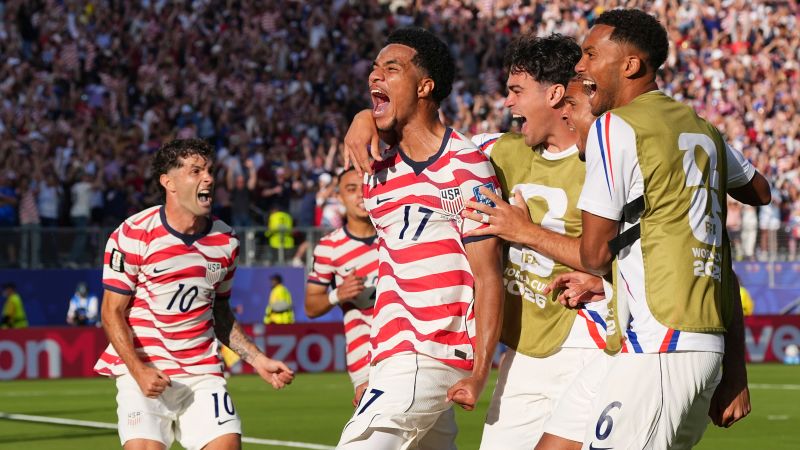
And Brooklyn-born Folarin Balogun, the son of Nigerian parents, who was brought up in England and now plays for Monaco, wouldn’t have been in the red, white and blue but for birthright citizenship. The bedrock constitutional principle has been under unprecedented challenge but was upheld by the US Supreme Court the day before Balogun scored for the US on Wednesday.
Team USA has been a huge reason for the nationwide party — but far from the only one. Bars and restaurants are crammed day and night for games, and are being invaded by visiting fans.
Some US cities, hollowed out by economic change and remote work policies, haven’t buzzed like this since before the pandemic, as fans in the shirts of multiple national teams pack the streets. The simple, cathartic ritual of gathering together for a common event, which feels quaint in an age of endless thumb-swiping, is the craze of the summer.
What’s refreshing about the USA’s success is that the team — like its more decorated women’s counterpart — is a rare common cause that anyone can bandwagon. Sports, like everything else in American life, is now part of a culture war after debates over players taking a knee or stars using their platforms to mock Trump.
With luck, the USA can avoid the fate of their ice hockey compatriots, whose stirring Olympic gold medal triumph over Canada was soon tainted by politics. A unifying force in a divided nation In its European and South American heartlands, football is a deeply political game.
Religious bigotry rains down from the terraces in Glasgow when the city’s big clubs, Rangers and Celtic, play. FC Barcelona has long been a hub for Catalan nationalism.
But the USA has the potential to do something the NFL has mastered: creating an experience that can be appreciated by all the country’s political tribes in polarized times. FIFA boss Gianni Infantino has been criticized for cozying up to totalitarian regimes and alienated many fans who don’t vote MAGA by awarding Trump a peace prize.
But he had a point last year in Los Angeles when lauding football’s capacity to bring people together. “We can see, well, actually this other person from this other part of the world, he’s not so bad or she’s not so bad as described, right?” he said. The global soccer supremo envisioned this year’s World Cup boosting the nationwide commemoration of the revolution. “When we learned that in 2026, there is the 250th anniversary of the United States, we thought, well, you know, you have a celebration — we organize a party,” Infantino said.
He didn’t anticipate that the World Cup would not just enhance the observance, but in its unifying potential, would stand in contrast to it. In days running up to July 4, official US semiquincentennial celebrations have been consumed by political controversy, fueled by Trump’s decision to take control of celebrations from a bipartisan congressional commission.
In contrast with the crowds spilling out of World Cup stadiums, official 250th anniversary events have been comparatively sparsely attended. CNN reported that Trump vented about attendance at his speech launching the Great American State Fair last week, which has hardly been packing out pavilions set out on the National Mall.
One reason for the underwhelming response might be that the president has not hidden his desire to make himself the center of the 250th. He delivered an intensely political speech on the Mall, declaring himself the equal of the founders in fostering American greatness.
Millions of Americans who voted for him in three elections might agree. But the president’s approval ratings are below 40%.
His injecting of political rhetoric into the big national party is bound to push away citizens who have a different definition of patriotism. Changing views of the US abroad Trump’s “America First” rhetoric has negatively reshaped many perceptions of the United States abroad, despite his claims the country has never been more respected.
The president’s hardline immigration policies and hostility to American allies, along with wall-to-wall media coverage of raids by ICE agents, fueled calls for a boycott of the US World Cup in Europe earlier this year. Foreign fans have flocked to the finals, but new figures published on Thursday by the Organization for Economic Cooperation and Development showed that while global international tourism arrivals in member states rose 3.4% in 2025, they fell by 5.5% in the US.
But those who stayed away are missing something special. Media coverage of the US outside the country often fixates on anti-Trump commentary, mass shootings, racial strife and the inequalities inherent when millions lack healthcare in the world’s richest nation.
But World Cup fans are discovering that, along with its contradictions, America is a more subtle and complex nation that it often appears from abroad. Cities have surpassed themselves in welcoming supporters of visiting teams.
It was no tea party when Scotland’s famed “Tartan Army” drank Boston dry and the kilted hordes marched through the streets behind pipers or mobbed Fenway Park for a Red Sox game. The smitten Boston Globe published a thank-you note, saying the Scots “came for the World Cup, but gave us something more.” The paper added, “We’ll never forget the joy you brought to our city.” The love runs both ways for visiting supporters.
They’ve marveled at truck stops the size of small European towns, plowed through US-size portions at restaurants and been staggered by US superstores. But beyond the social media posts highlighting American consumer abundance, many fans are seeing parts of America few visitors experience.
Tourists often stop only in New York or other East Coast cities, or vacation in Florida or California. But the geographical reach of a 48-team tournament also hosted by Canada and Mexico means the football is, to paraphrase a famous Heineken beer ad, going to parts other events can’t reach.
This includes conservative regions of the US that have long mystified Europe’s metropolitan elites reared on caricatures of gun-toting rednecks. Some fans are learning that whatever one’s politics, most Americans are open and friendly in a way that takes getting used to for standoffish foreigners.
Several global heavyweights sited training bases in the heartland. England bedded down in Kansas City, Missouri; Sweden chose Frisco, Texas; and Spain trained in Chattanooga, Tennessee.
But Algeria made the greatest impression. The city of Lawrence, Kansas, adopted the team as its own, with downtown storefronts decorated in team colors.
The University of Kansas marching band even showed up to welcome players with the Algerian National Anthem. With such episodes, Americans are adding their quintessential flavor to football.
International fans who usually get in big-game mood in grimy pubs with beer-soaked floors are learning the joys of tailgating. In Atlanta, supporters of Mexico, Ghana and Brazil mixed in fan zones with big screens.
Metropolitan areas with large immigrant communities, like Miami, Los Angeles and New York, turned into footballing paradises. There’s little of the tension that can mar games in Europe, where there’s a long history of football violence and infiltration of fan bases by extreme political movements.
European and South American fans are also discovering a more educated soccer audience than they might have expected. Many Americans have looked again at the game in recent years, partially thanks to expanded television coverage of top overseas club teams in England’s Premier League and Spain’s La Liga.
It’s normal to see a game from across the Atlantic playing on Saturday mornings on TV rigs set up by tailgaters outside the fall’s big college football games. And World Cup group stages and early win-or-go-home games have scored historic TV ratings.
Vast, glistening NFL stadiums have turned into sporting cathedrals for another type of football, impressing many foreign visitors. Of course, despite the World Cup’s popularity, millions of Americans are yet to join the party — or simply have no interest.
And a few weeks of a game mostly played by other countries isn’t going to make Americans’ political divides go away. But this summer’s action is a fun and unexpected tonic nonetheless.
How football is changing in America Global football is beginning to look at America in a different way. During the first US World Cup finals in 1994, a pervasive question in the media was whether soccer would finally “conquer” America.
The patronizing assumption was that neophyte Yanks used to insular homegrown sports like American football and baseball didn’t get the low-scoring artistry of the “beautiful game” that held the rest of the world in thrall. There’s less arrogance this time, perhaps appropriately at a moment when the US celebrates its break from a colonial power.
Soccer — the professional game, rather than the recreational version many Americans play as children — has never been more popular here. Perhaps it doesn’t need to “conquer” the United States.
The rest of the world’s game is unlikely to lay down the cultural roots that US sports take for granted, or that it enjoys in Europe or Latin America. There’s no room on a packed sports calendar that means the Super Bowl in early February, college basketball in March, the Masters in April, NBA playoffs in early summer, US Open tennis in September and baseball playoffs in October.
But the game is carving out its own spaces. Major League Soccer is becoming more than a retirement home for overseas stars like Inter Miami’s Lionel Messi.
Lower-level pro leagues and college soccer are increasingly credible, even if Americans are yet to embrace the cliffhanger concept of promotion and relegation. There’ll be more synergy with the global game when MLS switches from its high summer season to mirror European professional leagues that play through the winter next year.
New fans who’ve loved the World Cup so far — with the greats like Argentina’s Messi, France’s Kylian Mbappé, Norway’s Erling Haaland and England’s Harry Kane dueling for the golden boot as top scorer — will soon learn the best is yet to come. Knockout rounds between the world’s footballing superpowers create agonizing drama, and there’s always the possibility of the dreaded penalty shootout.
But with the final two weeks away, the legacy of the US World Cup in 2026 already seems secure. It’s making the world’s game more American, and more Americans are falling for football.
Information from CNN (Top Stories). Edited by: Noticias Today.
View original article ↗
💬 Comments (0)
Sign in or create your account to comment.