NASA's ambitious plan to build a permanent lunar city near the Moon's south pole
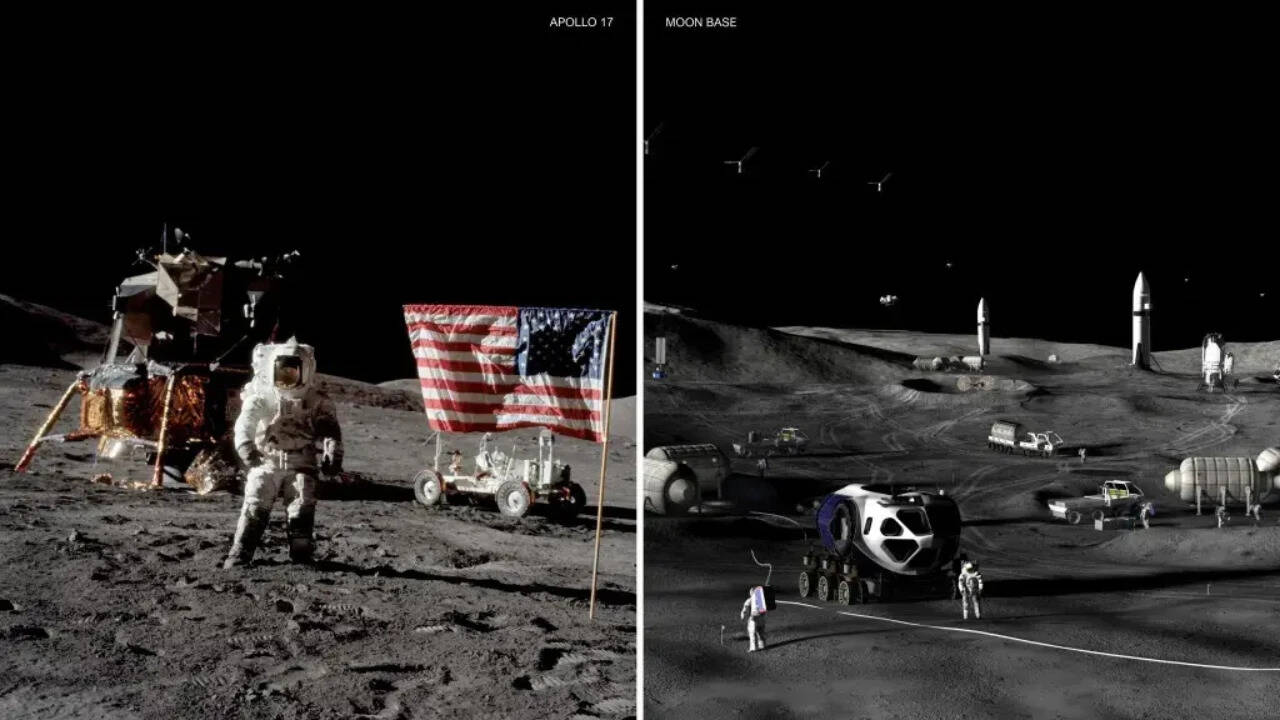
For decades, the Moon has remained a place of brief visits rather than sustained habitation, despite astronauts landing on its surface over half a century ago. NASA now aims to change this paradigm by establishing a permanent settlement near the south pole, envisioned not as a gleaming science-fiction metropolis but as a distributed network of habitats, power systems, autonomous vehicles, communication infrastructure and robotic explorers spanning hundreds of square miles. NASA chief Jared Isaacman emphasized the agency's commitment, stating that the goal is not merely to reach the Moon but to stay there permanently.
The lunar south pole was chosen as the focal point for this initiative because certain regions receive extended periods of sunlight while nearby craters remain permanently shadowed and exceptionally cold. Scientists believe these shadowed areas contain valuable water ice deposits that could be extracted to provide drinking water, oxygen for breathing, and hydrogen and oxygen for rocket fuel. Access to these resources would dramatically reduce dependency on costly resupply missions from Earth and enable longer-duration operations on the lunar surface.
NASA's three-phase plan spans more than a decade, beginning with robotic missions between now and 2029 to test technologies and deliver initial infrastructure. The second phase, from 2029 to 2032, focuses on expanding power systems and establishing communication infrastructure to support human habitation. The final phase, beginning in 2032, aims to establish sustained human presence with larger habitable modules and reliable power systems. The moonbase will include crew habitats, solar and nuclear power systems, cargo infrastructure, robotic systems and specialized lunar terrain vehicles capable of traveling hundreds of miles across the surface.
Significant technical challenges must be overcome, including protecting equipment and spacesuits from lunar dust, which is extremely fine, abrasive and electrostatically charged. Equally daunting is surviving the lunar night, which lasts approximately 14 Earth days with temperatures plunging to nearly minus 170 degrees Celsius. NASA plans to deploy radioisotope heater units and self-supported power generation systems to address these extreme conditions.
Beyond exploration, NASA's lunar program serves multiple strategic objectives. The initiative aims to unlock valuable resources including rare earth elements, iron and titanium; maintain American leadership as China targets lunar landing by 2030; test technologies essential for future Mars missions; and advance scientific understanding by studying lunar geology and composition. Success would represent humanity's first sustained home beyond Earth and a foundation for deeper space exploration.
Information from The Times of India. Edited by: Noticias Today.
View original article ↗



💬 Comments (0)
Sign in or create your account to comment.